
Executive Summary
Most Managed Service Providers begin life with technical excellence, not sales expertise.
Founders are typically engineers who built a successful business through exceptional service delivery. But as the business grows, a new challenge appears: generating predictable sales.
The good news is that successful MSP sales isn’t about becoming an aggressive salesperson. It’s about developing a series of habits that help prospects understand the commercial value behind your technical expertise.
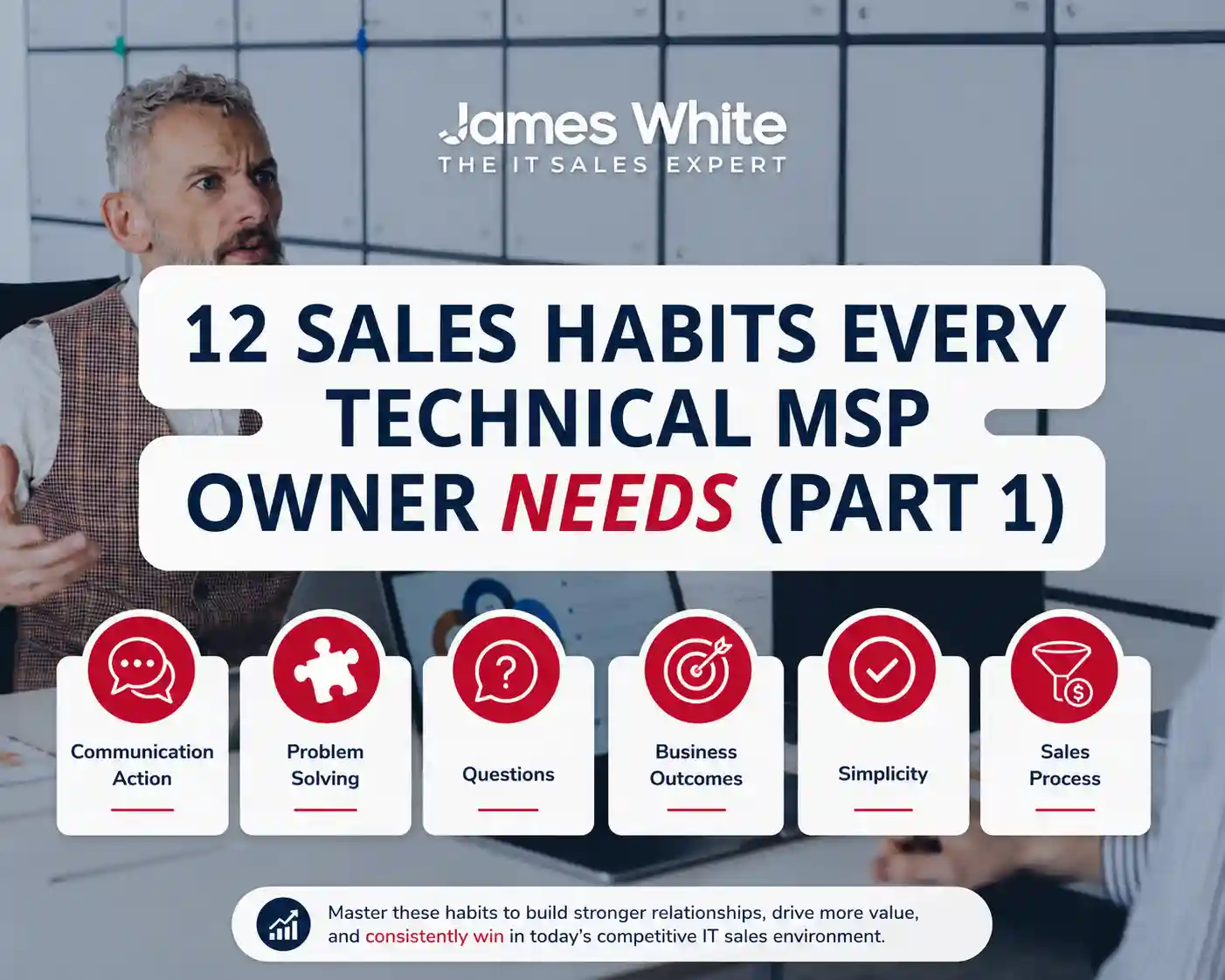
In Part 1 of this guide, I’ll share the first six sales habits that consistently separate growing MSPs from those that rely on referrals and luck.
Why So Many Technical MSP Owners Struggle With Sales
I’ve worked with hundreds of Managed Service Providers over the years.
One thing almost all technical founders have in common is this:
They know technology.
They know security.
They know Microsoft 365.
They know networking.
But when they’re sitting opposite a prospect, they often feel uncomfortable asking commercial questions, uncovering business challenges or leading a sales conversation.
The irony?
Many of the skills that make someone an excellent engineer also make them capable of becoming an outstanding salesperson.
You simply need to channel them differently.
Sales isn’t about convincing people.
It’s about understanding people.
Habit 1: Understand That Every Prospect Buys Differently
One of the biggest mistakes technical people make is assuming everyone processes information the same way they do.
Engineers often prefer:
- Logic
- Detail
- Evidence
- Facts
Many business owners don’t.
Some want you to get straight to the point.
Others need to build trust before discussing solutions.
Some focus on certainty and stability.
Others want the headline benefits first.
Learning to recognise different communication styles allows you to adapt your approach without changing who you are.
People buy from people who make them feel understood.
Habit 2: Focus on Solving Problems, Not Selling Services
One of the reasons engineers often dislike sales is because they imagine it involves persuasion.
It doesn’t.
The best MSP salespeople think exactly like great engineers.
They diagnose before they prescribe.
Every prospect is trying to achieve one of two things:
- Remove a problem
- Achieve a desired outcome
Your job is simply to determine whether your business can genuinely help.
When your focus shifts from selling to solving, conversations become more relaxed, authentic and effective.
Habit 3: Master Discovery Meetings With Better Questions
Most poor discovery meetings suffer from one simple problem.
The salesperson talks too much.
Great discovery meetings are built around curiosity.
Instead of responding immediately with solutions, keep exploring.
Prospect:
“We’ve had a few IT issues recently.”
Poor response:
“We can fix that.”
Better response:
“Tell me a bit more about that.”
“How often is it happening?”
“What’s the impact on the business?”
This is exactly why I teach my LAPS Framework:
- Listen
- Ask
- Probe
- Summarise
The first answer is rarely the real problem.
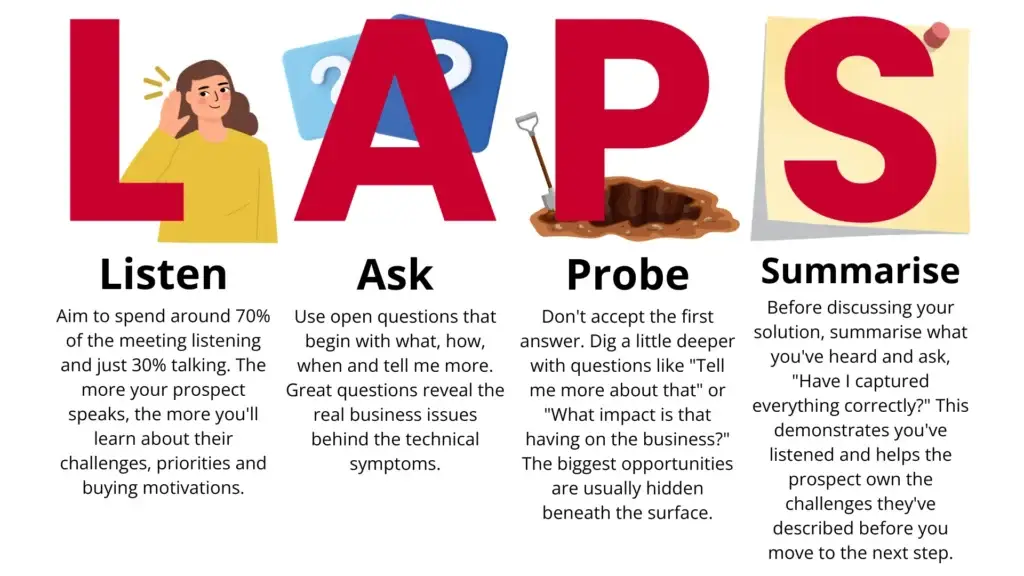
L – Listen
Aim to spend around 70% of the meeting listening and just 30% talking. The more your prospect speaks, the more you’ll learn about their challenges, priorities and buying motivations.
A – Ask
Use open questions that begin with what, how, when and tell me more. Great questions reveal the real business issues behind the technical symptoms.
P – Probe
Don’t accept the first answer. Dig a little deeper with questions like “Tell me more about that” or “What impact is that having on the business?” The biggest opportunities are usually hidden beneath the surface.
S – Summarise
Before discussing your solution, summarise what you’ve heard and ask, “Have I captured everything correctly?” This demonstrates you’ve listened and helps the prospect own the challenges they’ve described before you move to the next step.
Habit 4: Translate Technology Into Business Outcomes
Business owners don’t buy technology.
They buy certainty.
Nobody wakes up wanting:
- Microsoft Defender
- Conditional Access
- Immutable Backups
They want:
- Reduced business risk
- Greater productivity
- Less downtime
- Better client confidence
- Protected revenue
- Peace of mind
Whenever you explain a technical recommendation, immediately explain the commercial outcome.
That’s what people actually buy.
Habit 5: Remove Technical Jargon
One of the fastest ways to lose a prospect is through unnecessary complexity.
Terms like:
- JML
- SIEM
- RMM
- EDR
- Conditional Access
mean very little to many business owners.
Simple language doesn’t make you look less knowledgeable.
It makes your expertise easier to understand.
The clearer your explanation, the easier it becomes for a prospect to justify buying from you.
Habit 6: Remember That Sales Is a Process
Many technical founders expect one meeting to produce a new client.
In reality, high-value MSP sales happen over several conversations.
A typical buying journey might include:
- Initial conversation
- Discovery meeting
- Technical assessment
- Proposal
- Commercial discussion
- Decision
Your objective isn’t to close every meeting.
It’s to earn the next one.
When you understand each stage of your sales process and measure conversion rates between them, sales becomes far more predictable.
The Technical MSP Sales Shift
Technical Mindset | Commercial Mindset |
Explain technology | Understand business problems |
Present solutions | Diagnose challenges |
Demonstrate expertise | Build trust |
Talk about features | Discuss outcomes |
Close the deal | Earn the next conversation |
Sell services | Solve business problems |
Real MSP Example
Imagine a manufacturing company experiencing regular server outages.
An average MSP might explain:
- Server specifications
- Backup architecture
- Microsoft licensing
- Monitoring software
A stronger MSP asks:
- How often does production stop?
- How many employees are affected?
- What does one hour of downtime cost?
- What’s the impact on customer delivery?
Exactly the same technical solution.
Completely different commercial conversation.
Key Takeaways
If you’re a technical MSP owner, remember these six habits:
- Adapt your communication style to the person in front of you.
- Solve problems rather than trying to sell.
- Ask better questions.
- Probe beneath the first answer.
- Explain business outcomes instead of technical features.
- Treat sales as a structured process rather than a single meeting.
Master these habits and you’ll naturally become more confident in sales without ever feeling like you’re “doing sales.”
Frequently Asked Questions
Can technical people become good salespeople?
Absolutely. Many of the best MSP salespeople started as engineers because they’re naturally curious, analytical and excellent problem-solvers.
What's the biggest mistake MSP owners make during discovery?
Talking too much. The best discovery meetings are built around listening, asking questions and understanding business challenges before discussing solutions.
What does LAPS stand for?
LAPS stands for Listen, Ask, Probe and Summarise. It’s a structured discovery framework designed to help uncover business challenges before recommending solutions.
Why shouldn't MSPs focus on technical features?
Business owners don’t buy technology. They buy the outcomes technology delivers, such as reduced downtime, improved productivity, stronger security and greater peace of mind.