


Executive Summary
Lead scoring helps MSPs decide which prospects deserve attention by assigning points to meaningful actions, such as clicking a service email, downloading a guide or replying with interest. It gives you a clearer view of who is engaging, so you can spend your sales time more effectively.
There are two practical ways to use it: prioritise follow-up with your most engaged, suitable prospects, and create a different nurture campaign for contacts who have gone quiet. Start with a few simple scoring rules, choose a relevant time period and agree who will act when a contact reaches your review threshold. A score should start a better-informed conversation; you still need to understand the prospect’s needs, timing and ability to buy.
Why should MSPs use lead scoring?
We all want more hot opportunities dropping into our sales funnel. But what about the people already sitting in your CRM? The business owner who asked for a quote six months ago. The contact who downloaded your guide. The prospect who liked what you offered but wasn’t ready to move.
Not everyone is ready to buy straight away. Leaving them stone cold is an amateur move.
The challenge is finding time to keep in touch whilst running your business. This is where a simple system can help you understand WHO is paying attention and WHAT they are interested in, without checking every contact manually.
What is lead scoring?
Lead scoring means assigning points to information about a prospect or to actions they take. In this article, we are focusing on engagement: the things people do when they interact with your campaigns.
For a platform example, see HubSpot’s lead scoring documentation
HubSpot distinguishes engagement scores from fit scores, which assess characteristics such as company size or job role. For an MSP, both questions matter: is this person interested, and is their business one you can serve well?
1. How do you score your most engaged prospects?
Start with a small number of actions that matter to your business. Here is the simple example I shared in my Saturday Sales Email:
Prospect action | Points added | Running total |
Clicks a key service email link | 10 | 10 |
Downloads a guide through a form | 20 | 30 |
Replies positively to a follow-up SMS | 10 | 40 |
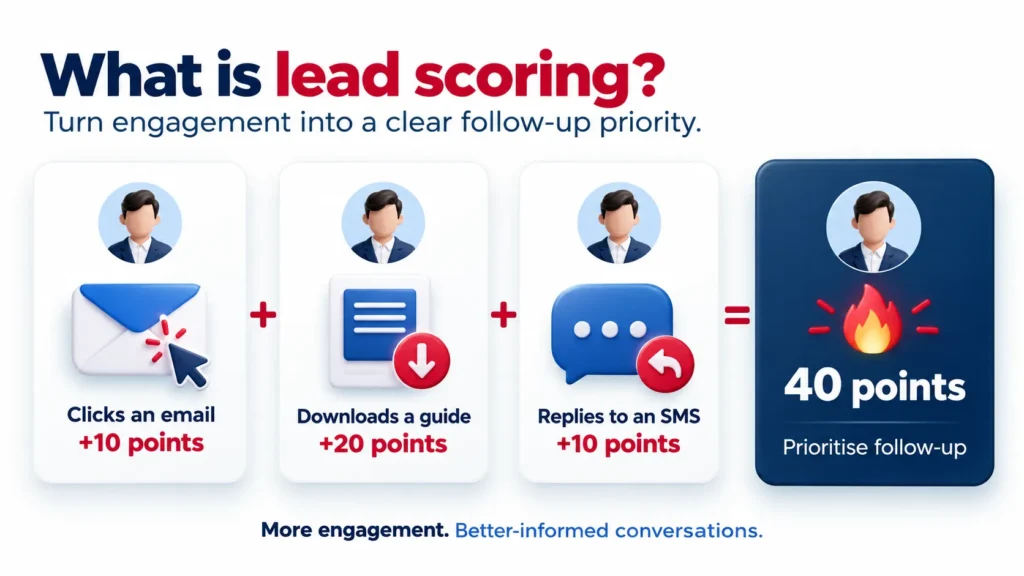
The same prospect completes three actions and reaches 40 points. Someone who only clicks the email link has 10 points. You now have a useful starting point for deciding whose activity to review first.
The meaning of the action matters. “Yes, tell me more” is very different from “Please stop contacting me”. Review the reply before treating it as a positive signal.
Choose a useful scoring window
A click from last week and a click from two years ago should not carry the same weight indefinitely. You might review the last 30 days for a short campaign, or a longer period such as 180 days for a slower sales cycle. Choose a window that reflects how your customers buy.
Some platforms support score decay, which reduces the value of older activity. HubSpot documents this feature alongside time-based scoring rules. Check what your own CRM and subscription support.
What should happen when a lead score rises?
A score on a screen does nothing by itself. Someone needs to take action!
Agree a review threshold, assign an owner and use your CRM’s available filters or workflows to flag contacts for follow-up. Review their recent activity and previous conversations before getting in touch.
For example, imagine a prospect downloads your guide about changing IT providers and then responds positively to a follow-up. That gives you a relevant starting point: “When we last spoke, changing provider wasn’t a priority. Has anything changed with the support you’re getting?”
Use what you know to ask a better question, rather than launch straight into a pitch.
And if someone directly asks for a conversation or a quote, respond. Don’t make them collect enough points first.
2. How do you re-engage prospects who have gone quiet?
Scoring also helps you identify the people who aren’t engaging as much as you would like. It may be time to try a different approach.
Filter suitable contacts with low recent engagement. If your system uses star ratings, these might be your 2- or 3-star prospects. The labels matter less than having a clear reason for grouping them together.
Give them a relevant reason to respond
I sometimes use campaigns such as “What all of your other competitors are doing”, linking to a form or document that shows what others in their industry are doing. It is a hook that encourages people to engage with the content.
Tracking that response gives me another signal about their interest. For your MSP, the useful question is: what would this particular group want to understand? You could share a guide to comparing IT support proposals, a checklist for reviewing their current provider, or a question about an issue they raised before.
Use examples you can substantiate. The content needs to deliver on the promise that earned the click.
Let their response guide your next step
If a contact engages again, review the topic and decide whether a personal follow-up would help. If they say the timing is wrong, record when it would be useful to reconnect. If they ask you to stop, remove them from the campaign.
Keep the messages useful and relevant. Repeating the same pitch more often is unlikely to solve the problem.
Related reading: MSP prospecting: why consistency wins new clients
How can you start using lead scoring in your MSP?
Choose one service, one group of suitable prospects and a few meaningful actions to score. Agree how long activity should count, who will review the contacts and what the next step should be.
Then look at what happens. Are the higher-scoring prospects having useful conversations with your team? Are the quieter contacts responding to the new campaign? Adjust your approach based on those outcomes.
You do not need a complicated system to start. You need one that your team understands and actually uses.
“You do not rise to the level of your goals. You fall to the level of your systems.” — James Clear
Frequently asked questions about lead scoring
What is a good lead score?
There is no universal number. A score of 40 means something only within the rules you have created. Set an initial review threshold, then refine it by looking at which contacts progress into useful sales conversations.
Does a high score mean someone is ready to buy?
It signals engagement under your scoring rules. You still need to establish their need, business fit, decision process and timing. Use the score to prioritise a conversation.
Can I score contacts already in my CRM?
Yes, if your system supports scoring and holds the relevant activity or contact data. Check whether rules apply to historical activity, new activity or both before relying on the results.
How often should I review lead scores?
My recommendation is to review flagged contacts regularly during the working week and assess the scoring rules monthly at first. Direct enquiries should receive prompt attention regardless of score.
What should I send to low-scoring prospects?
Try content that addresses a relevant problem or a simple question about their priorities. Use their previous interests to guide the message, and respect requests to stop contact.
Need help turning CRM activity into sales conversations?
If you have contacts sitting in your system and no clear plan for engaging them, let’s talk. At James White Sales Success, we can discuss your sales operations and how lead scoring and nurture campaigns could support your MSP.