


Executive Summary
Many salespeople lose opportunities because they stop at the prospect’s first answer.
A prospect says they’re “reviewing options,” “not getting value,” or “having a few issues,” and the salesperson immediately starts talking about their services.
The problem is that the first answer is rarely the real answer.
The best salespeople understand that sales success comes from asking follow-up questions, listening carefully, and uncovering the real challenges beneath the surface.
In this article, I’ll explain why the sale is often hidden behind the prospect’s first response and how asking better questions can dramatically improve your sales conversations.
Most Salespeople Stop Too Early
Last week I wrote about what I called “The Stinky Aftershave.”
The central idea was simple:
Most salespeople walk into meetings focused on selling.
The best salespeople walk into meetings focused on understanding.
That is the mindset.
This week, I want to give you the method.
Because once you stop trying to sell, the obvious question becomes:
- How do you uncover what is really going on?
- How do you get beyond surface-level answers?
- How do you find the real problem that needs solving?
The answer lies in one simple principle:
The sale is in the follow-up question.
Why Is The First Answer Rarely The Real Answer?
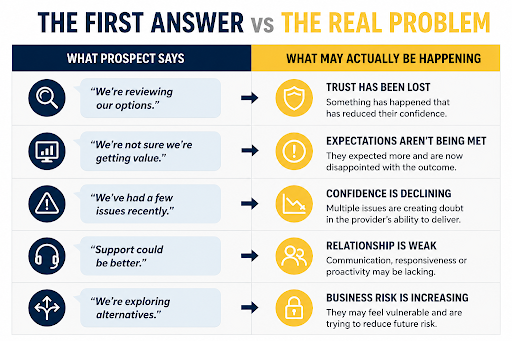
A prospect says: “We’re reviewing our options.”
And the salesperson immediately starts talking about their services.
A prospect says: “We’re not sure we’re getting value from our current provider.”
And the salesperson starts explaining why their support desk is better.
A prospect says: “We’ve had a few issues recently.”
And suddenly the salesperson is halfway through a presentation.
The problem is that none of these statements are the real problem.
They’re simply the starting point.
Great salespeople understand that:
- The first answer is rarely the answer.
- The first answer is the doorway.
- The real value is behind it.
What Questions Should Salespeople Ask Next?
When a prospect says: “We’re reviewing our options.”
A poor salesperson thinks: Excellent. An opportunity.
A great salesperson asks: What made you start reviewing your options now?
Then they listen.
And when they get an answer, they dig deeper.
For example:
- How long has that been happening?
- What impact is that having on the business?
- How frustrating is that for the team?
- What happens if it doesn't get fixed?
This is where sales happen.
Not when you pitch.
When you understand.
What Have I Learned From Working With Thousands Of Business Owners?
Over the last three decades, I’ve worked with thousands of business owners, salespeople and sales teams.
One pattern appears repeatedly.
The salespeople who consistently win more business are not usually the best presenters.
They’re the best listeners.
They don’t rush to recommendations.
They don’t immediately start talking about products.
They spend more time understanding the problem than explaining the solution.
Because of that, prospects trust their advice.
I’ve seen salespeople completely transform their results simply by becoming more curious and asking one or two additional questions before presenting their solution.
What's The Difference Between Hearing And Listening?
One of the biggest mistakes salespeople make is confusing hearing with listening.
Most salespeople hear.
The best salespeople listen.
They listen for:
- Emotion
- Frustration
- Hesitation
- Throwaway comments
- Underlying concerns
A prospect might say: “It’s not a major problem, but the team do complain about response times.”
Most salespeople move on.
Great salespeople stop.
Because they know they’ve found something important.
They ask:
- What are they complaining about specifically?
- How often does it happen?
- What impact does it have?
- Has it affected customers?
- What does your current provider say about it?
Now we’re getting somewhere.
Real MSP Sales Example
I see this regularly when working with MSPs and technology businesses.
A prospect initially says: “We’re just looking around.”
Many salespeople hear: Potential opportunity.
The best salespeople hear: Something has triggered this review.
Through questioning, we often discover:
- Poor communication from the incumbent provider
- Concerns about cyber security
- Lack of strategic guidance
- Slow response times
- A breakdown in trust
The original statement wasn’t the real issue.
The follow-up questions uncovered it.
Internal Resources You May Find Useful
If you found this article helpful, you may also enjoy:
Frequently Asked Questions
Why is the first answer rarely the real answer?
Because prospects often give surface-level responses initially. The underlying issue usually emerges through thoughtful follow-up questions.
How can I improve my discovery conversations?
Focus on understanding before presenting. Ask additional questions, explore impact, and avoid rushing to solutions.
Why are great salespeople good listeners?
Because listening helps uncover the real problem. Understanding the true challenge allows you to make more relevant recommendations.
What questions should MSP salespeople ask prospects?
Questions about business impact, frustration, risk, current provider performance, and what prompted the conversation often reveal valuable insights.
How many follow-up questions should I ask?
There is no magic number. Continue asking questions until you fully understand the problem, its impact, and why it matters.
Final Thoughts
The sale is not in the first answer.
The sale is in the follow-up question.
And then the next one.
And the one after that.
Because the deeper you understand the problem, the more obvious the right solution becomes.
The best salespeople are not the best talkers.
They are the best listeners.
So this week, challenge yourself.
Ask one more question than you normally would.
Then ask another.
And another.
You might be surprised by what you discover.