


Executive Summary
MSP sales opportunities rarely stall simply because a prospect is busy. More often, the deal stops moving because something important is missing from the buyer’s decision-making process.
In managed services, prospects are not just buying IT support. They are trusting an MSP with their systems, cybersecurity, data, uptime and business continuity. That means hesitation is often driven by risk, uncertainty, previous poor experiences, unclear value or a lack of urgency.
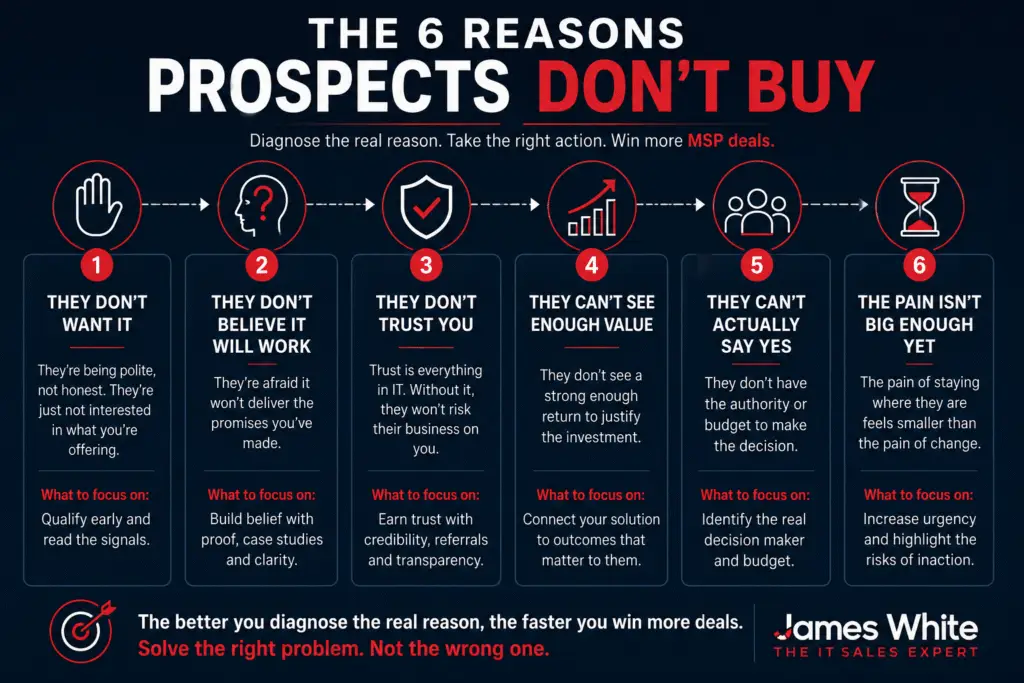
The six most common reasons MSP prospects don’t buy are:
- They don’t genuinely want it.
- They don’t believe it will work.
- They don’t trust you yet.
- They can’t see enough value.
- They can’t actually say yes.
- The pain isn’t big enough yet.
Understanding which one applies helps MSPs stop chasing the wrong problem and start moving better-fit opportunities forward.
Why Do MSP Sales Opportunities Stall?
One of the most frustrating moments in MSP sales is when a prospect appears interested, attends meetings, asks good questions, receives a proposal and then disappears.
The natural assumption is that they are busy.
Sometimes they are.
More often, there is something preventing them from moving forward.
The challenge is that prospects rarely tell you the real reason. Instead, they ask for more time, request extra information, stop responding or allow the opportunity to drift.
Across the MSPs James White Sales works with, most stalled opportunities can usually be traced back to one of six reasons.
1. They Don’t Genuinely Want It
This sounds obvious, but it happens more often than many salespeople realise.
People are polite. Most business owners do not enjoy telling someone directly that they are not interested, particularly if you have invested time in meetings and built a good relationship.
Instead of saying:
“We’re not interested.”
They say:
“We need some time to think about it.”
“Leave it with me.”
“Can you send some more information?”
The longer the sales cycle, the more likely this becomes. Rapport builds, relationships strengthen and prospects often become reluctant to deliver disappointing news.
Sometimes a stalled deal is not a sales problem.
It is simply a lack of genuine interest.
2. They Don’t Believe It Will Work
In managed services, this is one of the most common reasons prospects fail to move forward.
Many businesses have been let down by IT providers before. They have heard promises about fast response times, proactive support, strategic guidance and improved cybersecurity. Unfortunately, many have experienced something very different.
As a result, prospects are not just evaluating your proposal.
They are evaluating whether they are prepared to trust another provider with a critical part of their business.
This matters because MSPs are often responsible for areas that directly affect business continuity, cybersecurity and operational risk. CISA highlights that organisations using MSPs need to consider the risks associated with outsourced IT management, including access, security and resilience.
Most prospects will not openly admit this concern.
Instead, they ask for more case studies.
They request references.
They want another meeting.
What they are really saying is:
“Help me believe this will work for us.”
3. They Don’t Trust You Yet
Trust is the foundation of every successful MSP sale.
Without trust, nothing else matters.
MSPs are asking prospects to hand over responsibility for systems, data, cybersecurity, infrastructure and business continuity. That requires a significant level of confidence.
The challenge is that prospects rarely tell you they do not trust you.
Trust issues often appear disguised as:
- Delayed decisions
- Requests for additional proof
- Concerns about risk
- Reluctance to commit
- More stakeholders suddenly needing to be involved
This is why testimonials, referrals, case studies, customer success stories and social proof are so powerful.
People buy certainty before they buy solutions.
Building trust is one of the most important skills in MSP sales. As I discussed in Desperation is a Stinky Aftershave, prospects can quickly sense when a salesperson is trying too hard to close rather than genuinely understand their situation.
4. They Can’t See Enough Value
This is where many MSPs struggle.
The prospect says:
“It’s too expensive.”
The salesperson immediately starts considering discounts.
But price is rarely the real issue.
Value is.
Business owners do not buy managed services because they want monitoring, patching, endpoint protection or Microsoft licensing.
They buy because they want:
- Less downtime
- Fewer headaches
- Better productivity
- Reduced risk
- Greater security
- Confidence that technology is not holding the business back
This is important because downtime and IT disruption can have a significant commercial impact. Recent industry reporting has shown that unplanned downtime can cost large organisations substantial sums and damage reputation, productivity and customer confidence.
If your proposal focuses too heavily on technical features rather than business outcomes, prospects will struggle to justify the investment.
When buyers push back on price, what they are often saying is:
“I don’t yet see enough value to justify the cost.”
If price objections are a recurring challenge, you may find my article on How To Deal With Price Objections useful, where I explore the three most common causes of pricing resistance.
5. They Can’t Actually Say Yes
This is one of the most common qualification mistakes in MSP sales.
You spend weeks speaking to a prospect.
You understand their challenges.
You build a strong relationship.
You prepare a proposal.
Only to discover that the person you have been speaking to is not the person who can make the final decision.
Perhaps it is an Office Manager.
An Operations Director.
An Internal IT Manager.
Or a Finance contact.
They may genuinely support your proposal.
But support and authority are not the same thing.
Before investing significant time in an opportunity, MSPs need to understand:
- Who makes the final decision
- Who influences the decision
- How budgets are approved
- What the purchasing process looks like
- What would stop the project from moving ahead
Otherwise, you risk selling to someone who simply cannot say yes.
Qualification and process are critical. In How to Build a Scalable Sales System, I explain why documenting your sales process and identifying decision-makers early can dramatically improve conversion rates.
6. The Pain Isn’t Big Enough Yet
This may be the hardest lesson in MSP sales.
A prospect can agree with everything you have said.
They can acknowledge the risks.
They can recognise the weaknesses in their current provider.
They can even admit they need to improve.
And still do nothing.
Why?
Because the pain of staying where they are feels smaller than the pain of change.
Their support is not great.
But it is acceptable.
Their cybersecurity is not ideal.
But they have not suffered a breach.
Their systems are slow.
But the business is coping.
One of the biggest mistakes salespeople make is assuming awareness creates urgency.
It does not.
Prospects act when the cost of staying the same becomes greater than the cost of changing.
Until that happens, many opportunities remain stuck.
This challenge is particularly common in the MSP space. In The 7 Hard Truths About MSP Growth, I discuss why long sales cycles and delayed buying decisions are often a normal part of selling managed services.
What Should MSPs Do When a Deal Stalls?
The biggest mistake salespeople make is trying to solve the wrong problem.
They handle a price objection when the issue is trust.
They send another proposal when the issue is authority.
They increase follow-up when the prospect simply does not want to buy.
The better question is not:
“How do I chase this deal harder?”
The better question is:
“What is really missing?”
Most stalled MSP opportunities do not disappear because prospects are busy.
They stall because one of six things is missing:
- Genuine interest
- Belief
- Trust
- Value
- Authority
- Pain
The better you become at diagnosing what is really stopping the prospect from moving forward, the faster you will win more deals.
Because in sales, the solution is only obvious once you have identified the real problem.
What Questions Should Salespeople Ask Next?
When a prospect says: “We’re reviewing our options.”
A poor salesperson thinks: Excellent. An opportunity.
A great salesperson asks: What made you start reviewing your options now?
Then they listen.
And when they get an answer, they dig deeper.
For example:
- How long has that been happening?
- What impact is that having on the business?
- How frustrating is that for the team?
- What happens if it doesn't get fixed?
This is where sales happen.
Not when you pitch.
When you understand.
FAQ: Why MSP Prospects Don’t Buy
Why do MSP prospects go quiet after receiving a proposal?
MSP prospects often go quiet because they have an unspoken concern. They may not believe the solution will work, may not trust the provider yet, may not see enough value or may not have the authority to approve the decision.
Is price the main reason MSP deals stall?
Price is often the objection, but it is rarely the full reason. In many cases, the prospect cannot yet connect the cost of the MSP service to the business outcomes they care about, such as reduced risk, better productivity, fewer disruptions and stronger cybersecurity.
How can an MSP build more trust during the sales process?
MSPs can build trust by using relevant case studies, client testimonials, referrals, clear onboarding plans, transparent pricing and specific examples of how they have solved similar problems for similar businesses.
Why do prospects say they need more time to think?
Sometimes they genuinely need time. But often, “I need to think about it” means something else is missing. It may indicate a lack of belief, unclear value, hidden stakeholders, fear of change or weak urgency.
How can MSPs qualify decision-makers more effectively?
MSPs should ask early who is involved in the decision, how the budget is approved, what criteria will be used to compare providers and what the buying process looks like. This helps avoid spending weeks with someone who cannot approve the purchase.
What is the most common reason MSP sales opportunities stall?
In many MSP sales conversations, the most common reason is a lack of belief. Prospects may have been disappointed by previous IT providers and need evidence that this time will be different.