
What’s Next for Your Technology Business?
Grow, Sell, Transition or Step Back
A conversation between James White, The IT Sales Expert, and David Brooks, former CEO of RM and Charterhouse and now advisor to technology founders. Recorded as a live webinar on 15 October 2026.
You’ve spent years building your technology business.
You’ve dealt with the customer problems, made the difficult decisions and put in the hours that nobody else sees. You’ve built something of value.
But what do you want to happen next?
Do you still have the fire in your belly to grow it? Would you like to sell and realise some of that value? Or do you still enjoy owning the business, but wish it didn’t need quite so much of you?
These are questions I hear regularly from MSP owners and technology founders. Many have been building their businesses for 10 or 15 years. They’re proud of what they’ve achieved, but they’re not always sure they want another five years of the same.
I recently sat down with David Brooks, former CEO of RM and Charterhouse and now an advisor to technology founders, to explore the options.
David has led both a listed technology business and a private equity backed IT services business. I founded my own SaaS business in 2005 and exited in 2018. Between us, we’ve experienced the opportunities, difficult decisions and personal challenges that come with changing the direction of a business.
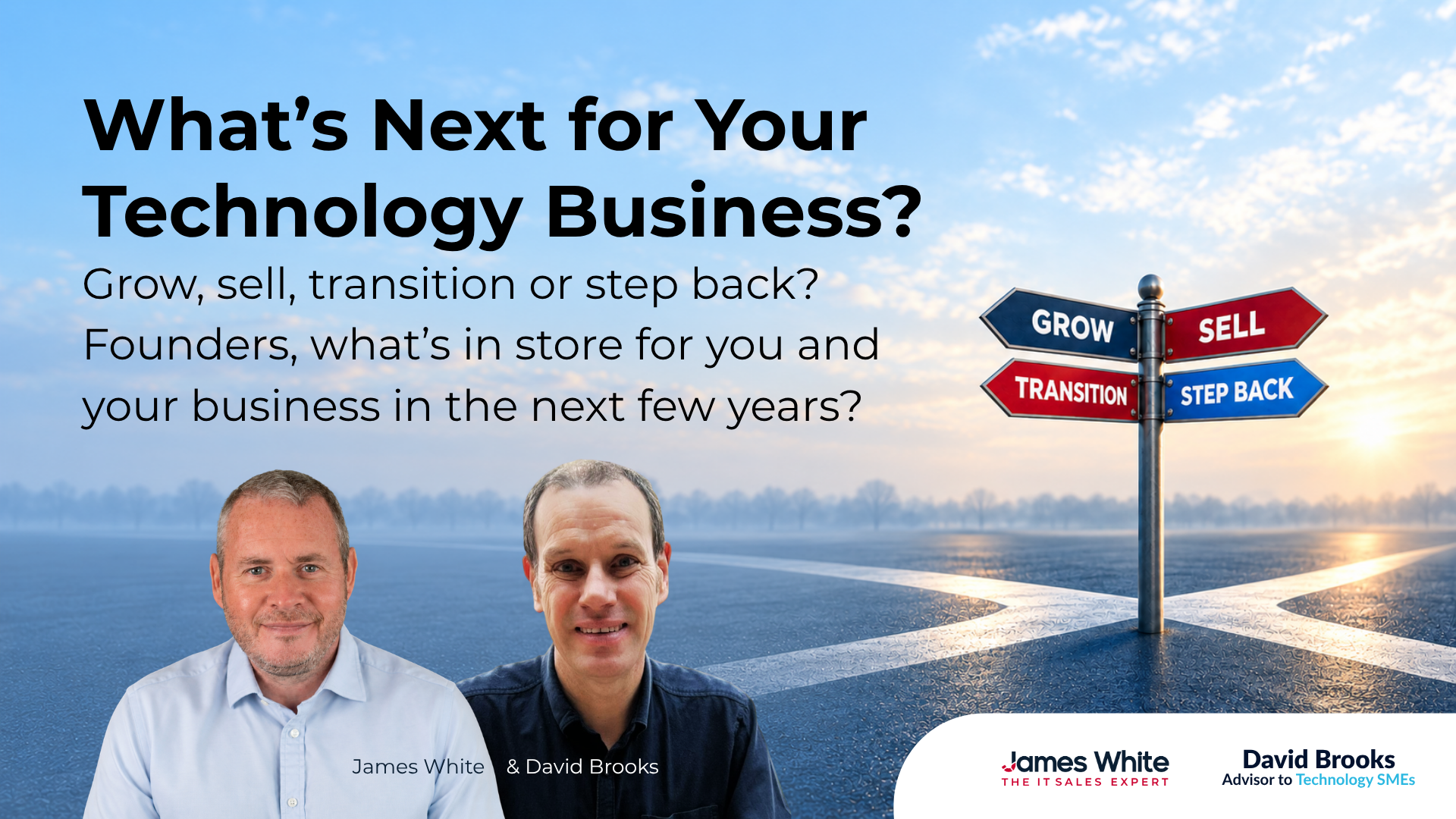
Our conversation centred on four routes: grow, sell, transition or step back.
As David pointed out, these aren’t mutually exclusive. You might grow and then sell. You might transition leadership before stepping back. You might sell part of the business and stay involved in its next stage.
The starting point is working out what you want from the business, and what role you want to play within it.
Grow Your Business
Growth can be exciting. More customers, a bigger team, greater visibility and opportunities that weren’t available when you were smaller.
When I built my SaaS business, we reached around 3,000 customers in approximately 40 countries, with just under half a million pounds in recurring revenue.
I wanted to build something bigger. But to support more customers and develop the application, we needed more people, more capacity and more structure.
That meant making a decision: fund the next stage ourselves or bring in external investment.
There was a real sense of pride in seeing the business grow. I would meet people who said, “I used your system,” and I didn’t even know them. We became more visible, which opened doors to partnerships and other commercial opportunities.
David sees growth as important whichever direction a founder ultimately chooses:
“If you’re looking for additional investment, looking to sell, or even looking to transition out, it’s made a lot easier if you’re growing. It gives you real options.”
Customers want confidence in the business they’re buying from. Employees want opportunities to develop. Growth can support both.
But you need to be honest about what it asks of you.
Do you want the job that comes with a bigger business?
Running a business with 50 people is different from running one with 10.
As David explained, founders often make most of the important day-to-day decisions themselves. As the business scales, they have to let go of some of those decisions.
Otherwise, everything continues to come back to them.
External investment brings another change. When I raised money, I gave up shares. Other people now owned part of the business and had expectations about how it would perform.
Raising that money also took time and energy. You can become so focused on investor conversations that you take your foot off the pedal commercially.
Then, when someone examines the numbers, the business isn’t performing as strongly as it was when the conversation started.
Acquisitions can offer another route to growth. David used them at RM. But bringing together two businesses also means bringing together different people, systems and cultures.
Before committing to growth, ask yourself:
- Do I have the hunger and energy for the next stage?
- Do I want the role and responsibilities that come with a larger business?
- How will we fund it?
- Who will keep driving performance while I work on investment or acquisitions?
- What does success look like for me in five years?
Then put a proper growth plan behind the ambition.
When I cycled from Somerset to Scotland, we had a plan for getting from one location to the next. Sometimes a road closure forced a diversion. We adjusted the route, but we still knew where we needed to get to.
Your business needs that same clarity: where you’re going, what it will take and how you’ll measure progress.
Sell your business
For some founders, selling is the right next step.
You may have achieved what you set out to do. You may want to start something else, spend more time with your family or take some money off the table.
But wanting to sell and being ready to sell are different things.
David shared the example of a founder who wanted to sell and be out within 12 months. Once they looked at the leadership team, growth record, systems and governance, it became clear that work was needed before meaningful sale conversations could begin.
The business had potential. It wasn’t yet ready for the outcome its owner wanted.
Can you prove the value you believe you’ve built?
Your business is your baby. You know how much work has gone into it.
A buyer will look at it differently.
They will want evidence behind the revenue, customer relationships and growth potential. They will examine contracts, financial information, employee arrangements and how the business operates.
David recalled joining a business that had previously made an acquisition, only to find that nobody could locate the acquired company’s customer contracts.
Those details matter.
I spoke to another founder who had received an initial valuation, only for the buyer to reduce it after discovering that several customers had no contracts in place.
The founder’s reaction was understandable: “You gave me a figure.”
But the buyer had now found something that changed their assessment.
One practical step is to start building a secure folder containing the information a buyer is likely to need. This is often called a data room.
Customer contracts, employee contracts, insurance documents and reliable financial records are all part of that preparation.
David also highlighted the value of customer satisfaction information collected over time.
A buyer will want to understand what customers think of your service, as well as what they spend.
What does leaving actually look like?
A sale doesn’t necessarily mean you hand over the keys and walk away.
Depending on the deal, you may need to remain involved during a transition or earn-out period. The terms matter as much as the headline number.
You also don’t have to sell the whole business. David explained that a partial sale can allow a founder to realise some value while remaining involved in future growth.
Before pursuing a sale, consider:
- When do I want to leave, and how realistic is that timescale?
- What still depends on me personally?
- Would I consider selling part of the business?
- What valuation and terms would I be comfortable accepting?
- How much involvement would I accept afterwards.
You will also need support. As David put it:
“The sales process is so intense and distracting.”
The business still needs to perform while you work through it. Think carefully about who will help manage the transaction and who will keep the business moving.
Transition leadership to someone else
Perhaps you still love the business, but you no longer want to carry every decision.
You may have people who have worked alongside you for years, and you’d like them to take the next step. You may want to mentor a new leader while remaining involved in the business you built.
David described a familiar example: moving from chief executive to non-executive chair.
The founder remains involved, but someone else takes responsibility for running the business day to day. That person might be promoted internally or recruited from outside.
It can bring fresh energy and ideas. But it only works if you give the new leadership team the authority to lead.
Can you let them do it differently?
I’ve struggled with this myself.
When I gave a management team greater control, I kept looking at what they were doing and thinking, “That’s not quite right.”
That wasn’t helping them.
If someone has responsibility for the business but has to check every decision with you, you haven’t really handed over.
You need agreed boundaries: which decisions they can make, which require your involvement and how you’ll assess performance.
Clear reporting, meaningful KPIs and disciplined board meetings help you stay informed without getting involved in everything.
David was particularly direct about the behaviour this requires:
“You can’t get ratty every time things go wrong, or go and talk to the sales team behind a manager’s back because you don’t like the way they’re managing, and undermine them.”
That’s an uncomfortable point for some founders. But if you want someone to lead, you have to give them room to do the job.
Choose people for their ability to lead
Loyalty matters. So does trust.
Neither automatically means someone is ready to run the business.
David has seen founders appoint people they like and have worked with for years, even when those people aren’t equipped for the role.
I’ve experienced that too. Someone wanted my job, but struggled when they got it.
Before handing over, work out what your successor needs to demonstrate. Give them opportunities to take responsibility and assess how they respond.
You also need to consider what’s in it for them.
If you want capable people to take on significant responsibility, their incentives need to reflect that. David’s view is that people should feel that creating value for the business also creates value for them personally.
Ask yourself:
- Who could genuinely lead the next stage?
- What do they need to demonstrate first?
- What support and development will they need?
- What authority am I prepared to give them?
- How will they share in the success they help create?
Then ask one more question: what will I do with the space this creates in my own life?
When you’ve spent years being needed, becoming less involved can be harder than you expect.
Step back while retaining ownership
Stepping back is closely connected to transition, but David made an important distinction:
“You’re splitting ownership control from management control.”
You still own the business. You no longer run it day to day.
You might want to pursue another business, travel or spend more time with your family. You might simply have had enough of the daily customer problems and people issues.
That doesn’t mean you’ve stopped caring. It means you want a different relationship with the business.
However, less involvement makes the quality of your team and reporting even more important.
When you’re in the business every day, you pick things up through conversations. You hear about customer concerns. You notice when someone is struggling.
Once you step back, those informal touchpoints reduce.
You need other ways to understand what’s happening.
How will you know the business is doing well?
You need to agree what gets reported, how often and when an issue requires your attention.
You also need to accept that the people running the business will make different decisions from you.
Some of those decisions may make you uncomfortable. That doesn’t automatically mean they’re wrong.
David raised another useful question: what happens if stepping back doesn’t work as planned?
Would you return to the business? Would you change the management team? Could you address the problem as an owner without taking over again?
Think that through before it happens.
And be clear about what you’re stepping back to.
As David pointed out, there’s little benefit in leaving all your money in the business, having nothing else you want to do and spending your days worrying about what’s happening.
You need a plan for your time and purpose as well as a plan for the business.
What’s stopping you from deciding?
Across all four routes, the same questions kept coming up.
What do you want? What does the business need? And how much are you prepared to change your own role?
These aren’t always easy conversations. Many technology founders keep their concerns to themselves because they feel they should already know the answers.
But you don’t have to work it all out alone.
David made a point that will feel familiar to plenty of business owners:
“It’s also so busy running your own business that you can always hide behind that.”
There is always another customer issue, another meeting or another decision that feels more urgent.
Meanwhile, the bigger question remains unanswered.
Take some time with a notepad and write down what you want the next few years to look like.
How involved do you want to be? What do you still want to achieve? What would you like to stop doing?
Then identify your first action.
That might be a conversation with your leadership team, an honest review of your growth plan or a discussion with someone who has been through the process.
You don’t need every answer before you begin. But you do need to begin.
Talk through your next step
If growth is part of your next chapter, I offer a free, one-hour Sales Review to look at your current sales approach and where it may be holding the business back.
If you want to explore the wider direction of your business, David can help you think through the options and the role you want to play.
Whether you choose to grow, sell, transition or step back, the decision needs to work for you.
You’ve put years into building this business. Give yourself the time to decide what you want from it next.
To start a conversation, email James at james@jameswhite.business or connect with James White and David Brooks on LinkedIn.