

Executive Summary
A sales methodology helps MSPs qualify opportunities consistently, uncover risks earlier and decide where to invest their time. By agreeing what information matters at each stage, your team can assess deals using evidence and identify the questions they still need to ask.
In this article, I explain how I helped a software and services provider introduce a six-stage sales process, supported by a simple scoring system. During our work together, the team went on to hit its sales targets for four consecutive months.
You’ll learn how to apply the same principles to your MSP, recognise when an opportunity needs further investigation and identify when it makes sense to walk away. Because if you are going to lose a deal, finding out earlier can save you a lot of wasted effort.
Why Should MSPs Aim to Lose Sales Deals Earlier?
Losing hurts.
Losing deals when you have spent countless hours on meetings, proposals and calls hurts even more. Yet it’s part of sales and something every one of us in business has to get used to.
We simply can’t win them all.
Sometimes there isn’t a fit. Sometimes the buyer has requirements you can’t meet. Sometimes a competitor has a stronger relationship, or the prospect wants a comparison quote to negotiate with their existing provider.
The key is to uncover this information early enough to make a sensible decision.
For an MSP, the time involved can quickly add up. You involve an engineer, review the prospect’s environment, scope a migration and put together a proposal. All while looking after your existing customers.
Before you commit that time, how much do you really know about the buyer’s willingness and ability to change?
That’s where a sales methodology can help.
What Is a Sales Methodology?
A sales methodology gives you a consistent way to understand buyers, qualify opportunities and decide how to move them forward.
Your sales process sets out the stages a deal moves through. Your methodology helps you establish what you need to understand and confirm within those stages.
For example, “proposal sent” tells you that your salesperson has completed an activity. It leaves several questions unanswered:
- Does the buyer agree that the problem needs solving?
- Have you spoken with the person who can approve the investment?
- Do you understand how they will make their decision?
- Have you agreed what happens after they receive the proposal?
A framework helps your team ask these questions consistently and record the answers.
It also helps you recognise when a friendly conversation is being mistaken for buying intent. I cover this further in Why MSP Prospects Say Yes When They Really Mean No.
What Happens When a Sales Team Has No Consistent Method?
In 2025, I worked with a large software and services provider. Their solutions and deal sizes were pretty chunky, but their commercial sales team weren’t hitting targets.
The MD asked me to come in and find out why.
I picked up several issues, including sales focus and confidence. Another significant problem was the lack of a clear sales process and methodology that everyone followed.
When we reviewed the pipeline and discussed the coming quarter, there was no consistent basis for the forecast.
Some salespeople relied on their gut feeling and relationships. Others used information gathered in meetings. Deals the team expected to win didn’t arrive. Occasionally, business nobody had discussed dropped in!
Those unexpected wins were welcome, but they also highlighted how little certainty we had about the pipeline.
Inconsistency kills confidence.
If everyone assesses opportunities differently, how can the sales leader compare deals or give the MD a forecast they believe in?
Should Your MSP Use BANT or MEDDPICC?
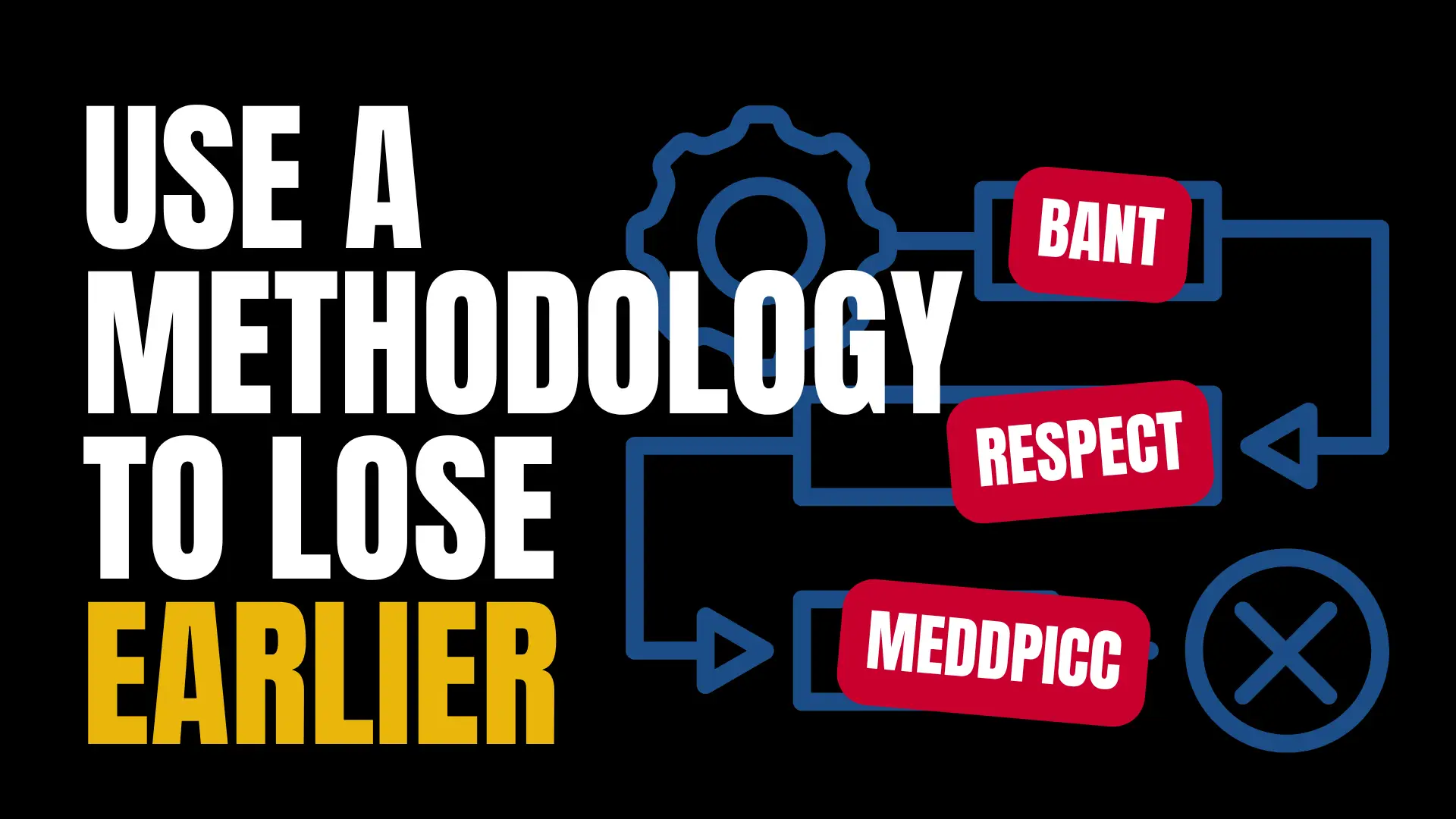
I discussed several frameworks with the team, including BANT, RESPECT and MEDDPICC. We eventually developed an approach based on MEDDPICC, adapted to their business.
BANT covers four qualification areas: Budget, Authority, Need and Timeline. It provides a straightforward structure for understanding whether an opportunity has the foundations to progress. Salesforce’s BANT guide explains these areas in more detail.
MEDDPICC examines a broader set of factors: Metrics, Economic Buyer, Decision Criteria, Decision Process, Paper Process, Implicate the Pain, Champion and Competition. This makes it useful for exploring complex deals involving several stakeholders and approval steps. See MEDDICC’s explanation of the methodology.
For your MSP, I would start by looking at the deals you sell.
A straightforward support agreement may need a lighter approach than a large outsourcing contract involving technical evaluation, finance, procurement and several decision-makers.
Choose a framework your team can apply properly. Then agree what evidence you expect them to gather.
Learning the acronym is the easy part. Using it honestly on every relevant opportunity takes discipline.
How Can You Build Qualification Into Your Sales Process?
With the software and services provider, we agreed six stages.
The table below follows those stages, with example questions adapted for an MSP.
Sales stage | What you need to establish | Example MSP qualification question |
1. Discovery | The problem and the reason for exploring change | “What has happened that has made you review your IT support?” |
2. Further scoping | The environment, requirements and likely fit | “What would we need to understand about your systems and users before recommending a solution?” |
3. Engage the economic decision-maker | Who can approve the investment and what matters to them | “Who will approve the investment, and what will they need to see?” |
4. Validate the solution | Whether the proposed approach meets the agreed requirements | “What would you need us to demonstrate to feel confident this will work?” |
5. Confirm the business case and proposal | The value, investment and remaining approval steps | “What needs to happen internally before you can approve this proposal?” |
6. Close or lose | The outcome and what can be learned | “What ultimately drove the decision?” |
Alongside the active stages, we agreed questions and criteria the salespeople would use to assess their opportunities.
This gave everyone a shared structure. It also made the next action clearer: gather the information needed to understand whether the deal could progress.
How Does Scoring Sales Opportunities Help?
The team assessed five agreed criteria at each active stage, scoring each from 1 to 4.
If they hadn’t asked about an area or had no supporting information, they scored it 1. If they had specific evidence, they could score it 4.
That gave them a total out of 20 for the stage.
The principle was simple: the stronger the evidence, the stronger the score.
If information was missing, the salesperson had to acknowledge that and decide what action would help them obtain it.
There is an important point here. A score of 16 out of 20 does not automatically mean an 80% chance of winning. It shows how well the opportunity meets your agreed evidence criteria. You still need to examine the gaps and their significance.
A deal could look strong in several areas and still have a serious obstacle, such as a requirement you cannot meet.
I remember one pipeline review where a salesperson looked at their own score and recognised that, without better evidence, they were unlikely to win.
They could see for themselves that they needed to investigate further or focus their attention elsewhere.
They were starting to lose earlier.
What Does Better Qualification Look Like for an MSP?
Imagine a prospect with 100 employees asks you to quote for managed IT support.
They complain about slow responses from their current provider. They like your approach and want a proposal.
It sounds promising.
But before involving your engineers and building the solution, you ask:
- “What impact are those slow responses having on the business?”
- “When does your current agreement renew?”
- “Who else will be involved in deciding whether to change?”
- “What would make moving providers worthwhile?”
- “What have you agreed internally about the review?”
You discover that your contact hasn’t discussed the problems with the finance director. They also don’t know when the existing contract ends.
You now have specific gaps to resolve.
The next step could be a meeting with the finance director and confirmation of the renewal date. That would give you a firmer basis for scoping the opportunity.
Alternatively, the prospect might explain that they only need another quote to challenge their current supplier’s price and have no intention of moving.
That information changes how much time you should invest.
This is an illustrative MSP scenario showing how to apply the approach.
When Should You Walk Away From a Sales Opportunity?
Missing information is common early in a sales conversation. Give yourself the opportunity to ask questions and understand the situation.
Then decide what the evidence tells you.
What you uncover | Sensible next action |
Important information is missing, and the buyer will help you obtain it | Agree the next step and continue qualifying. |
There is a good fit, but the timing is wrong | Agree when to reconnect and record the reason. |
A requirement falls outside what you can deliver | Explore whether an acceptable alternative exists; withdraw if it doesn’t. |
The buyer confirms they are only benchmarking and have no intention of changing | Reassess whether further proposal work is worthwhile. |
Critical questions remain unanswered after reasonable attempts | Review the opportunity’s priority and whether to continue investing time. |
The emotional part is often the hardest.
We picture the revenue. We think about what the deal would mean for the business. We have already invested time, so we feel compelled to keep going.
But the hours you have already spent cannot make an unsuitable deal suitable.
Your job is to make the best decision about the time you commit next.
What Results Did This Approach Produce?
Introducing the methodology took time. It was a new way of working, and the team had to become comfortable assessing their opportunities consistently.
Within a few months of working together, they started hitting their sales targets. By the time I finished the engagement, they had achieved target for four consecutive months.
They also felt more confident about their forecasts, and the MD had a clearer process for reviewing the pipeline.
The methodology formed part of our wider work on sales focus, confidence and structure. It gave us a practical way to examine deals and identify recurring problems.
For example, if opportunities repeatedly reached scoping and turned out to need solutions the business couldn’t provide, that raised questions about the leads being generated.
If decision-maker access was consistently missing, that highlighted a coaching need.
The reviews became useful for improving how the team sold, as well as assessing individual deals.
Frequently Asked Questions About MSP Sales Qualification
Can a small MSP use a sales methodology?
Yes. A founder handling sales alone can use the same principles as a larger team. Keep the questions proportionate to your deals and record the evidence, outstanding gaps and next actions.
Does losing earlier mean giving up too easily?
It means investigating whether an opportunity is worth pursuing and acting on what you learn. An unanswered question may justify another conversation. A confirmed barrier you cannot overcome may justify withdrawing.
Should every deal use exactly the same questions?
Use consistent core criteria, then adapt the questions to the buyer and the stage. A small support contract and a complex outsourcing agreement may require different levels of investigation.
How often should you review qualification?
Update it after meaningful buyer conversations and review it during your regular pipeline meetings. Confirm whether the evidence still applies and what has changed since the previous review.
How Can You Make Your MSP’s Sales Results More Consistent?
Start with the opportunities already in your pipeline.
Choose one and ask your salesperson, or yourself:
“What evidence do we have that this buyer is willing and able to move forward?”
Then identify what you still need to know and agree an action to find out.
The same discipline that makes consistent MSP prospecting effective needs to continue once an opportunity enters your pipeline.
Good salespeople know they can’t win them all. They learn to recognise where their time can make a difference.
Have you got a sales methodology that everyone in your MSP works with?
If you’d like help putting one in place, send me a message and tell me how you currently assess your opportunities. I’d love to help you build greater consistency into your sales results.