


Executive Summary
MSP prospects do not always tell you what they really think. A hesitant ‘yes, that sounds fine’ may actually mean the price feels too high, the change feels risky or they simply want to end an uncomfortable conversation. Salespeople with Happy Ears hear the word yes and assume the deal is moving. Strong salespeople notice when the words, tone and behaviour do not match. They slow down, make it safe for the prospect to disagree and ask a better follow-up question. This article explains how to recognise a counterfeit yes, why MSP buyers use one and how the SAFE framework can help you uncover the truth before you spend weeks chasing an opportunity that was never going anywhere.
- Listen beyond the words – hesitation, pace and tone often reveal what a polite answer hides.
- Make honesty safe – give the prospect permission to disagree without feeling awkward or pressured.
- Explore now, not after the proposal – an uncomfortable truth today is more useful than silence next week.
Why Aren't Prospects Always Honest in Sales Conversations?
The majority of us do not like confrontation.
We do not enjoy criticising someone. We do not want to upset them. And when we are tired, busy or simply not in the mood for a long conversation, it is often easier to say everything is fine and move on.
I was guilty of this myself recently.
I stayed at a pub in Oxfordshire ahead of an early customer meeting. Hotel prices are sky high, and I do not like overpaying for a room when I will be there for less than 12 hours. I found somewhere reasonably priced and did not expect luxury. The room was average at best – small, squeaky floorboards, but it had a bed and a bathroom. It did the job.
The pub was in the middle of a village, I was tired and there was nowhere else nearby, so I decided to eat there. The menu offered home-cooked Indian food. I ordered the butter chicken and looked forward to a decent meal.
Then it arrived.
It was served on a metal tray that looked as though it belonged in a prison canteen. The sauce was watery. The rice was pale. The whole thing looked like it had come from a packet or a supermarket ready meal. I tasted it. It was bang average.
Two minutes later, the owner came over and asked: ‘Is everything OK with your food?’
I had two choices.
- Tell him the truth – politely explain that I was disappointed with the presentation, taste and quality, then give him the opportunity to put it right.
- Tell him it was fine – avoid the awkward conversation and let him walk away believing everything was OK.
Guess which one I chose?
Option two.
I lied. Not with any great conviction and not because I wanted to mislead him. I was tired. I did not want ten follow-up questions. It was easier to say ‘it’s fine’ than explain what I really thought.
Your prospects and customers do exactly the same thing.
“A polite yes can be far more dangerous than an honest no.”
James White
What Is a Counterfeit Yes in Sales?
Former FBI hostage negotiator Chris Voss calls this a counterfeit yes. It sounds like agreement, but it does not contain genuine commitment.
In MSP sales, it often sounds like this:
‘Our managed service is £125 per user per month. How does that sound to you?’
‘Yes… that sounds fine.’
On paper, that looks positive. In the room, it may feel completely different. The answer is slower. The voice is flatter. The prospect looks away. Their energy drops. They say yes, but everything around the word says no.
Amateur salespeople hear the word and move on. They have Happy Ears.
Great salespeople notice the mismatch. They do not accuse the prospect of being dishonest. They gently reopen the conversation and make it easier for the prospect to say what they really think.
Why Do MSP Prospects Give a Counterfeit Yes?
Most prospects are not trying to trick you. They are trying to protect themselves from discomfort.
- They want to avoid confrontation. Saying the price feels too high or the proposal feels wrong may create a debate they do not want.
- They expect you to defend the price. If previous salespeople have responded to every concern with another pitch, honesty can feel like hard work.
- They are not yet sure what is wrong. Sometimes the concern is instinctive. The buyer senses risk but cannot immediately explain it.
- They do not want to disappoint you. The better the rapport, the harder it can feel to say, ‘I do not think this is right for us.’
- They want a quick exit. ‘Send me the proposal’ is sometimes a polite way to finish a meeting, not a request to buy.
This is particularly important in managed services. Changing MSP is not a small decision. The prospect is thinking about disruption, cybersecurity, access to systems, onboarding, their staff and whether your support will really be better than the provider they already know.
As I explain in Why MSP Prospects Don’t Buy, concerns about trust, value and risk often exist long before the proposal. The problem is that nobody creates the space for the prospect to voice them.
How Can You Spot a Counterfeit Yes?
You are looking for a gap between what the prospect says and how they say it.
1. Their Tone Changes
A confident prospect normally sounds certain. If their voice becomes quieter, slower or colder as soon as price, commitment or switching is mentioned, do not ignore it.
2. Their Language Becomes Vague
Listen for phrases such as ‘sounds fine’, ‘should be OK’, ‘I think so’, ‘leave it with me’ and ‘send something over’. None of these is a commitment on its own.
3. Their Energy Drops
A prospect who was engaged suddenly stops asking questions, gives shorter answers or looks ready to finish the meeting. Something may have changed.
4. They Avoid a Specific Next Step
They like the idea of receiving a proposal but will not agree who needs to see it, when it will be reviewed or when you will speak again.
5. Their Behaviour Does Not Match Their Words
They tell you the service looks good, but refuse to share user numbers, contract dates, stakeholders or a realistic decision process. Interest without action is not commitment.
The SAFE Framework: How to Uncover What a Prospect Really Thinks
The best response is not to challenge the prospect. It is to make the conversation feel safer. I use a simple four-step approach:
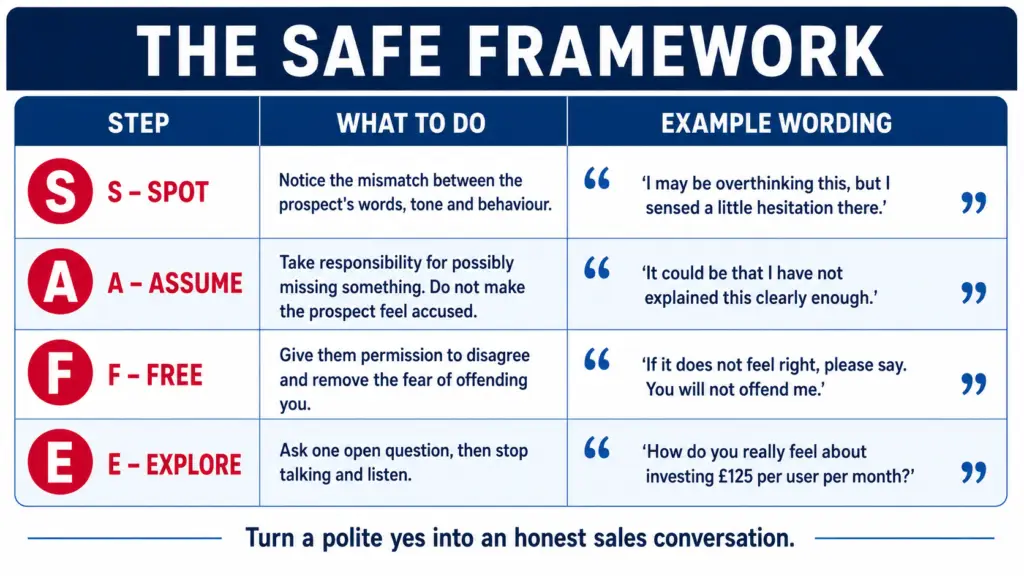
Be careful here. A pause is not automatically an objection, and a quiet person is not automatically uninterested. You are not trying to become a mind reader. You are noticing a signal and checking it respectfully.
Put together, it might sound like this:
‘Appreciate your thoughts, Sarah. Look, it is probably just me overthinking this, but I sensed you were not totally sure when I mentioned the price. It could be that I have not explained the value clearly enough. If it does not feel right, please tell me – you will not offend me. How do you really feel about investing £125 per user per month?’
Then be quiet.
Do not rescue them from the silence. Do not answer your own question. Let them think.
Brené Brown’s line, ‘Clear is kind. Unclear is unkind.’ applies perfectly here. Giving someone permission to be clear is kinder than allowing both sides to pretend the deal is fine.
What Does This Sound Like in Real MSP Sales Conversations?
Example 1: The Price Sounds 'Fine'
Prospect: ‘Yes, £125 per user sounds fine.’
Salesperson: ‘I might be wrong, but I heard a little hesitation. If the figure feels higher than you expected, it is absolutely fine to say so. What is your honest reaction to it?’
The real answer may be that the prospect expected £90 per user, that they have not included the cost of Microsoft licensing in their budget or that they simply cannot yet see enough value. Now you have something useful to discuss.
Example 2: They Say Switching Provider Is Not a Concern
Prospect: ‘No, the changeover should be OK.’
Salesperson: ‘You sound a little less certain than you did a moment ago. Is there anything about onboarding or disruption that is worrying you?’
The prospect may then explain that their last migration caused two days of disruption. That is not an objection to brush aside. It is the key to the sale. Show them your onboarding plan, risk controls and evidence from clients who made a similar move.
Example 3: They Ask You to Send a Proposal
Prospect: ‘This looks good. Send me a proposal and I will share it with the team.’
Salesperson: ‘Happy to. Before I do, can I check something? If the proposal reflects what we have discussed, what happens next – and who else needs to believe this is the right move?’
If they cannot explain the next step, you may not have a genuine opportunity yet. Better to discover that before spending half a day writing a proposal.
If the prospect does reveal a concern, use the LAIR method for handling objections: Listen, Acknowledge, Identify and Respond. The objective is to understand the objection, not squash it as quickly as possible.
Why Is an Honest No Better Than a Counterfeit Yes?
Salespeople love yes. It feels like progress. It makes the pipeline look healthy. It gives everyone a little hit of optimism.
But a yes without a next step, decision process or real commitment is not progress.
An honest no can save you weeks of follow-up. It tells you where you stand. It allows you to qualify the opportunity out, return at a more suitable time or address the genuine issue while you still have the prospect’s attention.
This is why the best salespeople do not fear difficult answers. They would rather know the truth now than chase a comfortable lie later.
Not every hesitation means no, of course. Sometimes it reflects normal caution. My article on understanding buyer hesitation explains why patience and risk reduction are often more effective than pressure.
What Happens If You Ignore a Counterfeit Yes?
- Your pipeline becomes misleading. Opportunities appear healthier than they really are, making forecasts unreliable.
- You waste time and energy. You write proposals, arrange demos and send follow-up emails for a buyer who was never comfortable moving forward.
- You solve the wrong problem. You discount when the real issue is trust, send more technical detail when the real issue is risk or chase one person when the decision sits elsewhere.
- The prospect feels pressured. Every follow-up becomes harder to answer, so avoidance turns into silence.
- You lose the chance to improve. Just like the pub owner, you walk away believing everything was fine and never discover what the customer really experienced.
How Can MSP Leaders Train Their Teams to Hear the Truth?
This is not a skill you develop by reading one article. You have to practise it.
- Review real calls. Listen for moments where the prospect’s tone changed and identify the follow-up question that should have been asked.
- Role-play awkward answers. Practise price hesitation, switching anxiety, hidden stakeholders and the classic ‘send me something’.
- Reward honest qualification. Do not punish salespeople for removing weak deals from the pipeline. A smaller, truthful pipeline is more valuable than a large fictional one.
- Measure next-step quality. A proposal sent is not a meaningful milestone unless the review date, stakeholders and decision process are clear.
- Coach curiosity, not cleverness. The salesperson does not need the perfect rebuttal. They need the confidence to ask one more question and listen to the answer.
The very best salespeople practise difficult conversations before they happen. That preparation makes it much easier to stay calm when a prospect gives an answer you were not hoping to hear.
The Most Valuable Answer Is the Honest One
The moral of the story is simple.
You have to listen to what people are really telling you – not just the words you want to hear.
Most prospects will not purposely lie. They want to avoid confrontation. It feels easier to say ‘sounds fine’ and ignore your follow-up than to challenge you directly in the meeting.
Sales experts spot the soft signals. They understand tone. They notice hesitation. And most importantly, they know how to create a conversation in which the prospect feels safe enough to be honest.
The next time you hear a yes that does not sound like a yes, do not celebrate too quickly.
Slow down. Use SAFE. Ask the extra question.
The answer may not be the one you want. But it will be the one you need.
Key Takeaways
- A prospect can say yes simply because disagreement feels uncomfortable.
- Tone, energy and behaviour can reveal hesitation that the words conceal.
- Never accuse a prospect of being dishonest; take responsibility and give them permission to disagree.
- Use the SAFE framework: Spot, Assume, Free and Explore.
- An honest no is more valuable than a counterfeit yes because it protects time, pipeline accuracy and trust.
Frequently Asked Questions
What is a counterfeit yes in sales?
A counterfeit yes is a positive-sounding answer that does not reflect genuine agreement or commitment. Prospects often use it to avoid confrontation, escape a pressured conversation or postpone sharing a concern.
How can I tell if a prospect's yes is genuine?
Look for consistency between their words, tone and actions. A genuine yes is normally followed by specific questions, agreed next steps, access to decision-makers or a clear buying process. A vague yes with no action deserves a respectful follow-up question.
What should I say when a prospect sounds hesitant about price?
Try: ‘I may be wrong, but I sensed some hesitation when I mentioned the price. If it feels higher than expected, please say – you will not offend me. What is your honest reaction?’ Then listen without defending the figure.
Does hesitation always mean the prospect is not interested?
No. Hesitation may reflect normal caution, internal approval, fear of disruption or a need for more evidence. The purpose of the follow-up question is to understand the reason, not assume the answer.
Why do MSP prospects go quiet after receiving a proposal?
Often an unspoken concern was never uncovered during discovery. It may relate to price, trust, switching risk, value or decision authority. The proposal does not always create the problem; it often exposes a concern that was already there.
Is it better to get an honest no early in the sales process?
Yes. An honest no saves time, improves pipeline accuracy and may reveal a future opportunity. It is far more useful than spending weeks following up with someone who never intended to move forward.
How can MSP sales managers coach this skill?
Use call reviews and role-play to practise recognising tone changes, asking permission-based follow-up questions and staying silent after the question. Managers should also reward accurate qualification, not just the number of deals left in the pipeline.
Ready to Create More Honest Sales Conversations?
At James White Sales Success, we help MSP owners and sales teams improve discovery, uncover objections earlier and build a more predictable pipeline of genuine opportunities.
If too many prospects say the right things in meetings and then disappear afterwards, send James a message. We can help your team ask better questions, hear what is not being said and move the right opportunities forward.