

Executive Summary
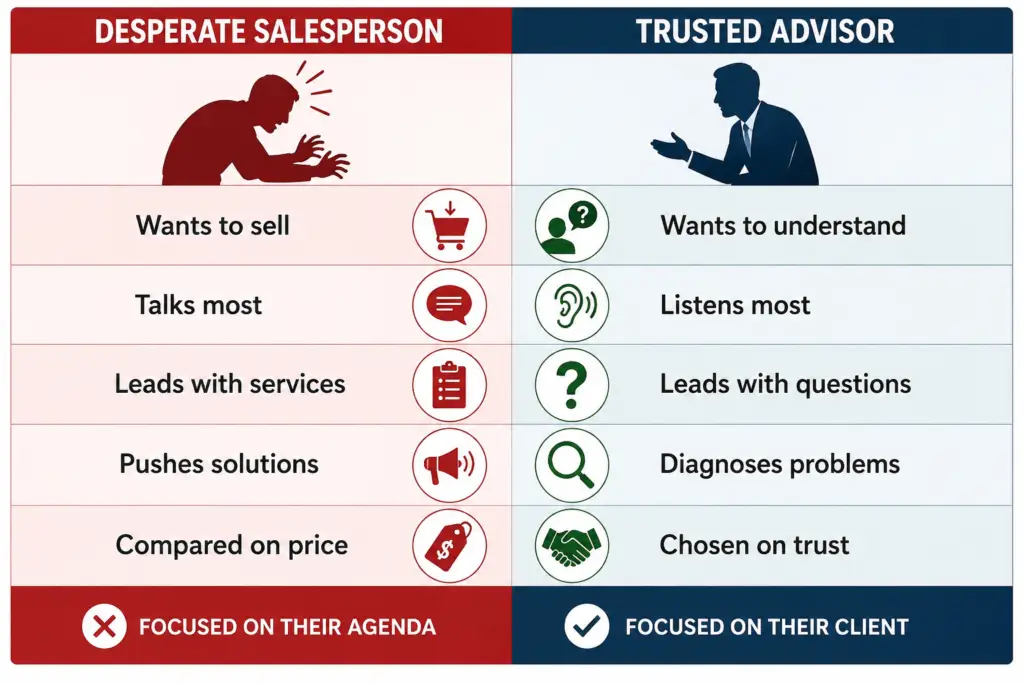
Desperation is one of the biggest deal-killers in sales. When prospects feel a salesperson is focused on selling rather than understanding, trust disappears and the salesperson becomes just another vendor. The best salespeople approach conversations as problem-solvers, listening carefully, asking insightful questions and focusing on the prospect’s challenges before recommending a solution. The less desperate you are to sell, the more likely you are to make the sale.
Desperation is a Stinky Aftershave
You might not notice you are wearing it, but everyone else in the room can smell it.
And in sales, especially in IT and MSP sales, I see this all the time.
A salesperson walks into a meeting with a prospect and, whether they realise it or not, their whole energy says: “I need to sell something here.”
They want to pitch.
They want to prove themselves.
They want to explain the service.
They want to tell the prospect how good they are, how experienced the business is, how quickly they respond to tickets, how strong their cyber credentials are, how brilliant the onboarding process is and how they are different from every other MSP in the market.
And here is the brutal truth.
Most prospects don’t care.
Not yet anyway.

The prospect isn’t thinking about any of that.
They are thinking about themselves:
- Their problems.
- Their frustrations.
- Their risks.
- Their challenges.
Before they care about what you do, they need to believe you understand what they are dealing with.
That is where so many salespeople go wrong – they walk into meetings with a preconceived idea of what they want to sell, instead of being curious about what needs to be solved.
And prospects can feel it.
They might not say it. They might sit politely and listen. They might nod along and let you finish your pitch. But deep down, they are thinking: “This person is not listening to me. They are just waiting for their turn to talk.”.
The moment that happens, you stop being an advisor.
You become a vendor.
And vendors get compared on price.

The funny thing is that many business owners were actually better salespeople before they ever hired a salesperson.
I see this regularly when working with MSP owners and IT businesses. The businesses that consistently win new clients focus on diagnosis first and recommendations second.

Not because they had sales training.
Not because they had a CRM.
Not because they had some fancy discovery framework.
They were better because they cared about solving problems
When you started your business:
You didn’t lead with a presentation.
You didn’t start with your packages.
You didn’t launch into a list of features.
You sat down and tried to understand what was wrong.
You wanted to know what was causing frustration.
You wanted to know what wasn’t working.
You wanted to know what was keeping the customer awake at night.
You focused on the problem.
And because you focused on the problem, people trusted you.
As businesses grow, they often lose this.
They replace curiosity with process.
They replace listening with pitching.
They replace problem-solving with product explanation.
And then they wonder why conversion rates start falling.
The truth is simple.
Most prospects don't want your pitch.
Not yet.
They want to know whether you understand their world.
Whether you understand the consequences of getting it wrong.
Whether you genuinely care about helping them.
Trust comes before solutions.
Trust comes before proposals.
Trust comes before sales.
And trust is impossible to build if your prospect feels like you’ve already decided what you’re going to sell before you’ve understood their situation.
The best salespeople aren’t obsessed with making a sale.
They’re obsessed with understanding the problem.
In fact, one of the most effective ways to do this is through structured questioning. I’ve written previously about my LAPS methodology and how it helps salespeople uncover what prospects are really thinking and feeling.
Because when prospects feel understood,
they relax,
they open up,
they tell you more,
and they trust what you recommend.
That’s when sales become easier.

But here’s the important thing…
Mindset Before Method
Whenever I work with sales teams, people often ask me, “What’s the best sales technique?” or “What questions should I ask?”
The truth is, the technique doesn’t matter if the mindset is wrong.
If you walk into a meeting desperate to sell, no script in the world will save you.
If you walk into a meeting determined to understand, you’ll naturally ask better questions, listen more carefully and build more trust.
The mindset comes first.
The method comes second.
And next week, I’ll show you exactly what that method looks like.
I’ll share how the best salespeople uncover what is really going on beneath the surface, why the first answer is almost never the real answer, and how a few simple follow-up questions can completely transform your sales conversations.
Spotting the stinky aftershave is one thing.
Knowing what to wear instead is another.
We’ll cover that next week 🙂
In conclusion, the irony is that the less desperate you are to sell, the more likely you are to make the sale. People buy from people who are trying to solve their problem, not people who are trying to hit a target.
So next time you walk into a meeting, leave the stinky aftershave at home.
Don’t go in determined to sell.
Go in determined to understand.
That’s my view anyway…
If you’d like to hear me expand on this topic, I’ve also discussed the importance of curiosity, questioning and trust-building on the podcast.
Do you agree with me?
Have you ever been on the receiving end of a salesperson who was trying far too hard to sell?
Or have you caught yourself doing it?
Let me know. I read every reply, even if I don’t always get chance to respond to them all.
Thanks as ever for being part of my community.
Have a brilliant sales week ahead and remember, Eat or be Eaten.
Frequently Asked Questions
Most prospects don’t dislike salespeople; they dislike feeling sold to.
When a salesperson launches straight into a pitch, the prospect immediately feels like the conversation is about the salesperson’s targets rather than their own challenges.
Buyers want to feel understood before they hear recommendations. They want confidence that you understand their situation, the risks they face, and the outcomes they are trying to achieve.
The best sales conversations start with curiosity, not a presentation.
The simplest way to avoid sounding desperate is to stop focusing on what you want to sell and start focusing on what the prospect needs to solve.
Desperate salespeople enter meetings hoping to present their solution.
Trusted advisors enter meetings hoping to understand the problem.
Ask questions, listen carefully, and avoid rushing to explain your services. The more interested you are in understanding the prospect, the less pressure they will feel from you.
Ironically, that often makes them far more willing to buy.
Many founders become successful because they built their business around solving a specific problem.
When they meet prospects, they naturally focus on understanding the challenge rather than delivering a sales pitch.
They ask questions because they are genuinely curious.
As businesses grow, sales processes and presentations often replace that curiosity. The challenge for sales teams is to maintain the same problem-solving mindset that helped the founder win customers in the first place.
Trust is built when a prospect feels heard, understood, and respected.
That means asking thoughtful questions, listening without interrupting, and taking the time to understand the full situation before offering advice.
Many salespeople rush to recommend a solution after hearing the first problem.
The best salespeople dig deeper.
They explore the impact of the problem, why it exists, how long it has been happening, and what happens if nothing changes.
The more thoroughly you understand the prospect’s world, the more credibility your recommendations will have.
The purpose of a discovery meeting is not to sell managed services.
The purpose is to understand the prospect’s business.
Focus on uncovering:
- Current frustrations with IT
- Business risks and vulnerabilities
- Cyber security concerns
- Productivity challenges
- Previous experiences with IT providers
- Future growth plans
- The consequences of doing nothing
The more clearly you understand the problem, the easier it becomes to determine whether your services are genuinely the right fit.
A good discovery meeting should leave the prospect feeling understood, not pitched to.
Because the first answer is rarely the real problem.
A prospect might say they are unhappy with response times, but the real issue could be a lack of trust, poor communication, cyber security concerns, or frustration that their provider is not being proactive.
Great salespeople understand that valuable information is often hidden beneath the first answer.
By asking thoughtful follow-up questions, they uncover the real challenge, which allows them to provide better advice and more relevant solutions.
As I often say, the sale is not in the first answer.
The sale is in the follow-up question.

“Over the last 30 years, I’ve worked with more than 5,000 business owners, salespeople and sales teams. One pattern appears repeatedly: the salespeople who focus most on understanding the problem consistently outperform those who focus on presenting the solution.
Prospects rarely buy because of the best pitch. They buy because they feel understood.
The Difference That Wins Deals